DEVELOPMENT DIARY

InDomino’s
dev diary.

From the first prototype to the demo. Changes, step by step, with recordings of how the game used to look.

UPDATE · SEPTEMBER 12–13, 2026

Rounding the corners without losing depth

Panel and button borders gained the dominoes’ proportions. Then came the curve adjustment, outside and inside.

The dominoes already had a more pronounced border, but the score panels and buttons still looked thin beside them. The adjustment started with that difference: use the tile as a reference for border thickness and corner size.

Panels came first. Then buttons received the same proportions, without increasing their size or changing colors, text, or clickable areas.

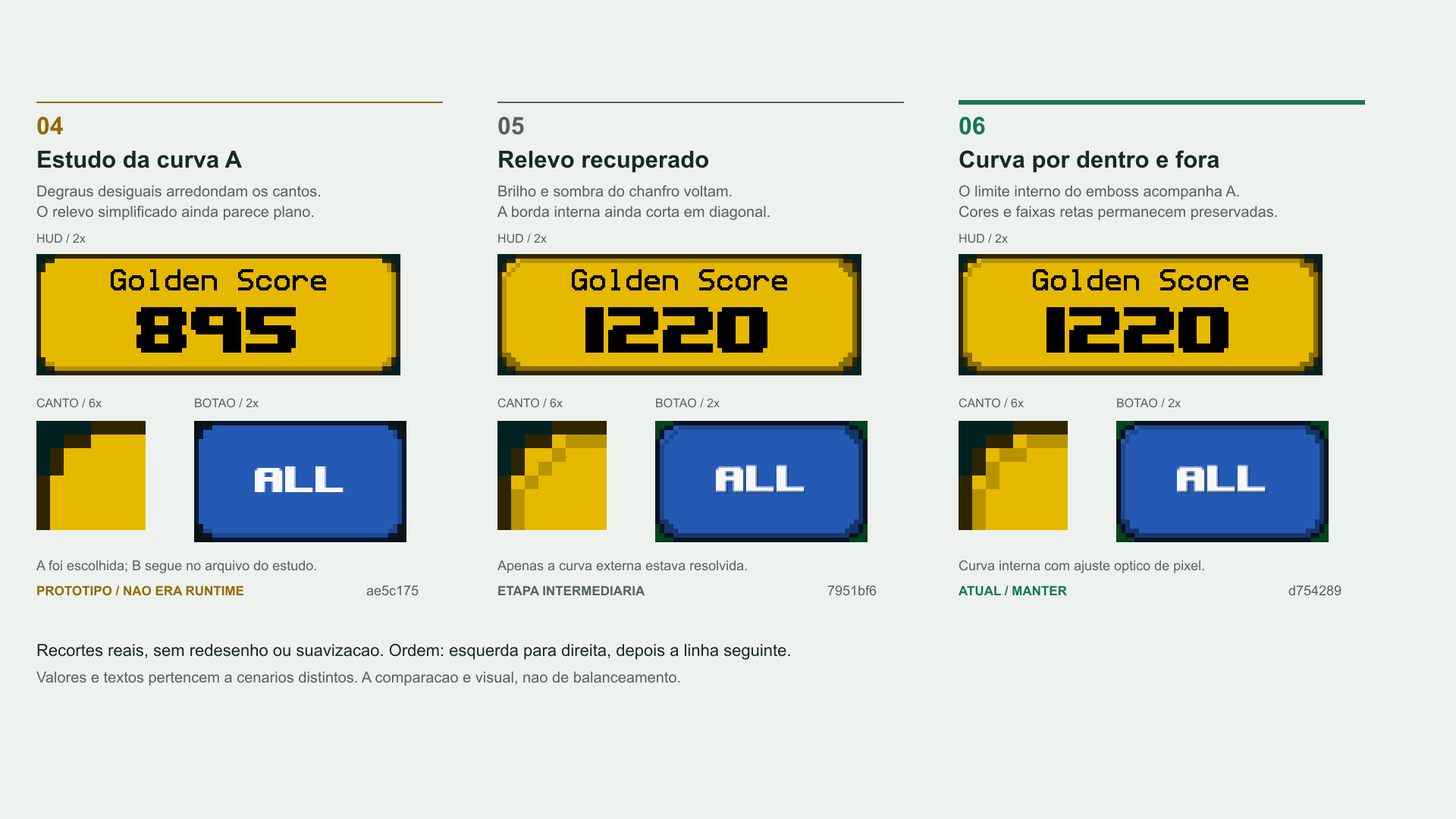
Rounding the corners revealed another detail. The study brought the shape closer to the dominoes, but lost the highlights and shadows that gave the border depth. This option was still a visual test, not the version used in play.

Restoring the depth solved one part. The outside corner was rounded; inside, the border still closed diagonally. In the next revision, the inner curve followed the outer one while preserving the finish of the straight sections.

These adjustments belong to the development version from September 12 and 13. They are not in the site’s demo yet.
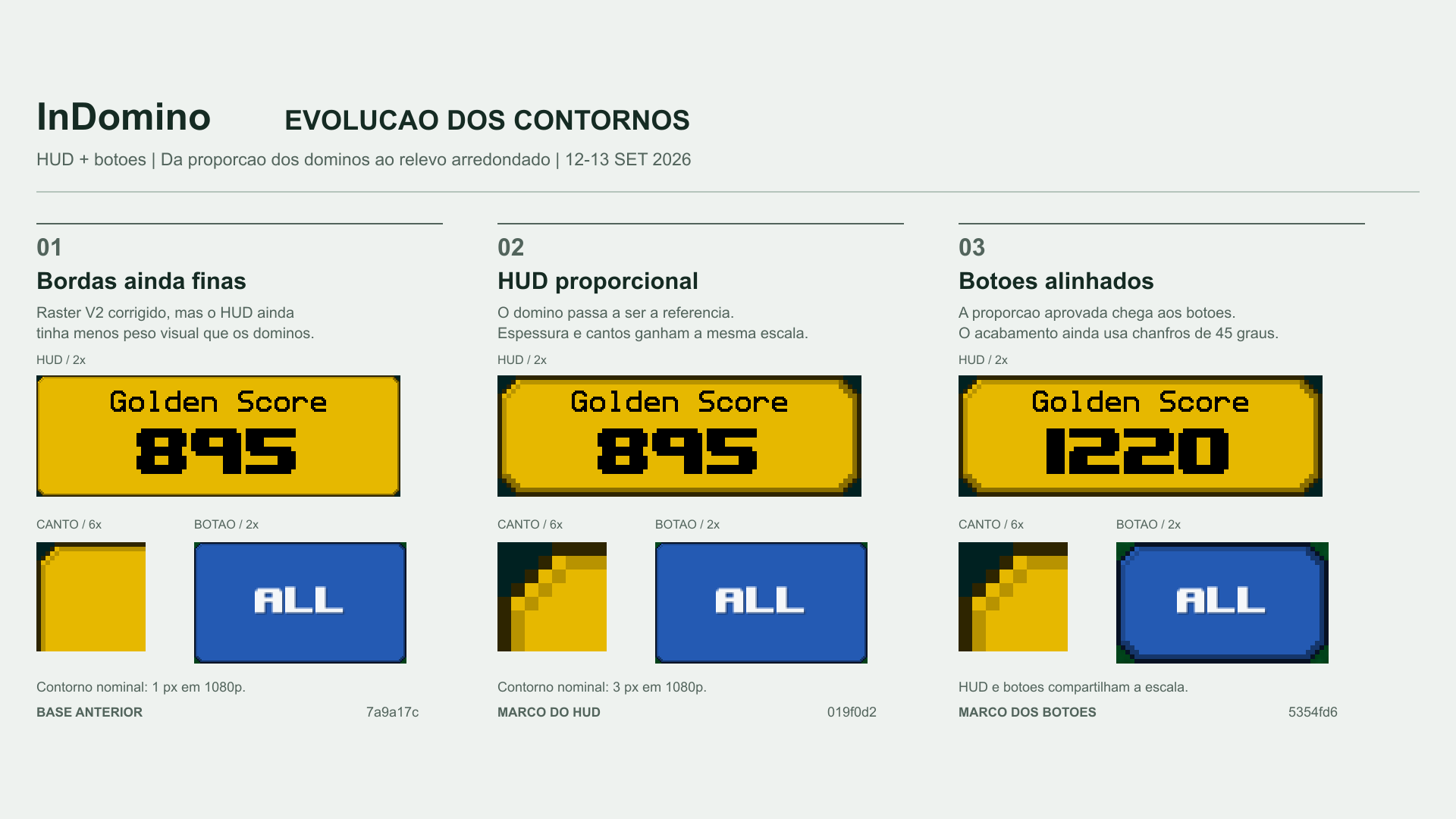
Border steps 1 to 3: a panel and button with thin borders, a panel with a thicker border, and a button adjusted to the same proportions.
Steps 1 to 3: thin borders, adjusted panels, and matching button proportions. Comparison assembled from test captures. Click to enlarge.
Border steps 4 to 6: a curve with simplified depth, restored highlights and shadows with a diagonal interior, and a result with a curved inner border too.
Steps 4 to 6: curve study, restored depth, and the inner-border correction. Step 4 was a visual study, not the version used in play. Click to enlarge.

RELEASE · SEPTEMBER 13, 2026

You can play the demo now

The first three stages are available in your desktop browser, with keyboard and mouse. No installation needed.

You can now play InDomino here on the site. The first demo contains the campaign’s three opening stages and runs in a desktop browser, with keyboard and mouse.

It is a short slice: build your first sequences and try to reach the targets. Bosses are not included. The campaign’s first encounter happens at stage 5, and it was not moved forward to fit the demo.

After your third win, the demo ends and you can start another run. Progress is saved in this browser when storage is available. If the browser blocks saving, the page tells you and the game continues.

The full campaign is still in development, with 25 stages and five bosses. For now, you can get to know the game at these three tables. The “Play the demo” button is at the top of the page.

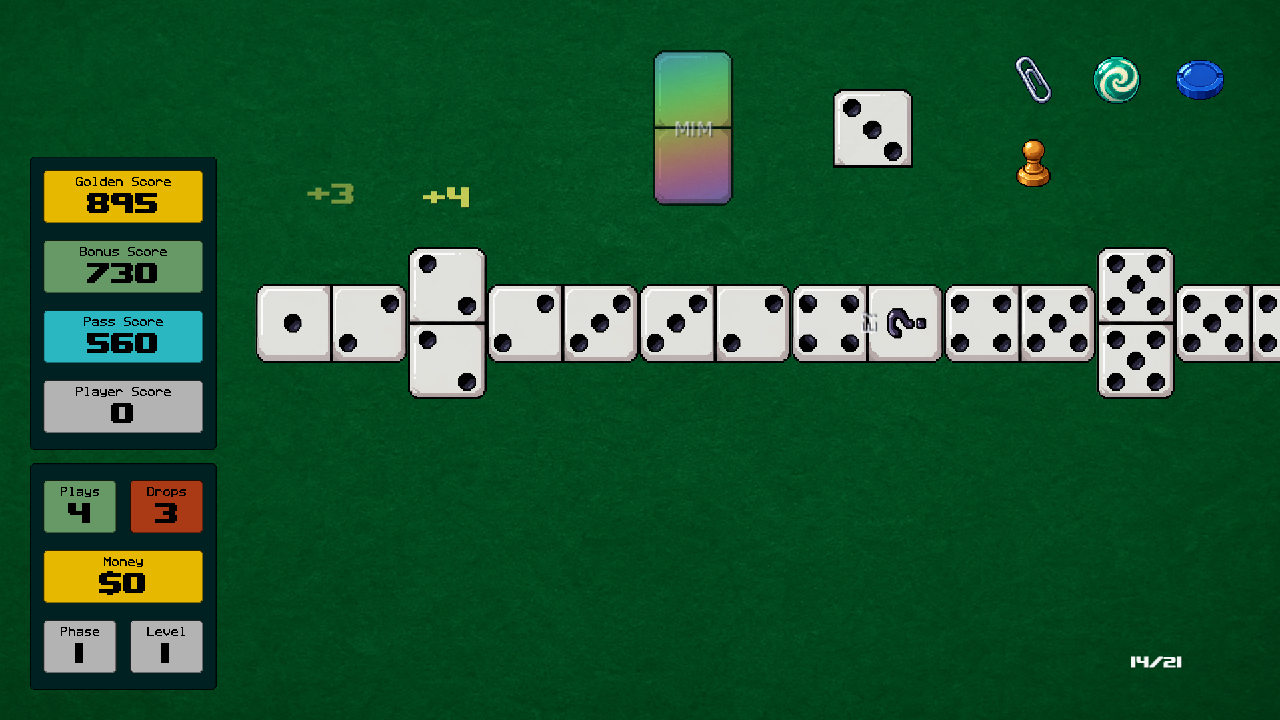
Echo joins sections of the chain, with double tiles and pocket items.
A scene arranged in the test version. These tiles and items are not in the published demo.

RETROSPECTIVE · SEPTEMBER 12, 2026

First, the game in the test browser

InDomino started running in a local web version. The public demo still needed loading, saving, and publication.

On September 12, InDomino was already running in the browser in a local test version. You could check the image and interaction with the table, but there was no public demo on the site yet.

In the same phase, bosses gained temporary expressions to signal some effects. Score panels were also rearranged in the order Golden, Bonus, Pass, and Player.

The difficulty study covered all 25 stages and found results outside the expected ranges. But those numbers came from a simplified simulation, not a person playing the campaign.

The results stayed as a reference for investigation. They were not enough to start changing the game’s values.

Running locally was one step. Opening the demo through the site still required checking loading, saving, and publication.

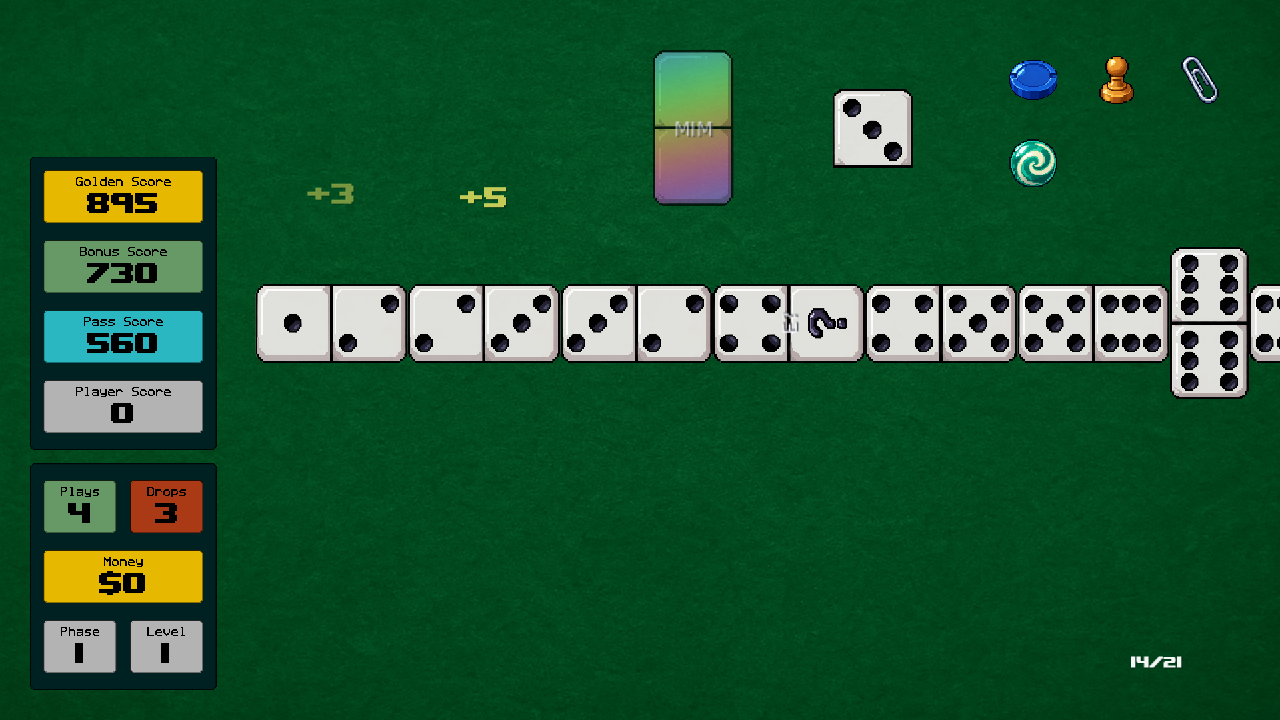
A long chain with Echo and points appearing on the table, alongside specials and pocket items.
A current test-version scene, arranged to show the point count.

RETROSPECTIVE · SEPTEMBER 11, 2026

Resuming without changing the run

Native saves started preserving the random sequence. Victory, defeat, and restarting also received adjustments.

Closing and reopening the game should not change the random sequence of a saved run. In the native version, resuming started preserving that sequence alongside the rest of the state.

Endings received work too. Victory and defeat gained adjustments to the summary, restart options, and what remained on screen after the result.

Fixes addressed temporary states carried between stages and Echo’s presentation. These were details that needed resolving before continuing or starting another run.

The changes were checked in test scenarios and Windows packages. This delivery, recorded on September 11, concerns the native version. Browser saving still needed its own verification.

Those tests record specific situations. They do not replace someone playing through a complete run.

RETROSPECTIVE · MARCH 22–MAY 11, 2026

One tile changes, the rest follows

Levels, specials, wear, and saving started demanding more attention to combinations between features.

A tile can gain a level, receive a special, and need to return in the same state after a save. The adjustments from this phase reached those combinations.

Between March and May, I worked on support-item wear, level displays, and used tiles. Each change needed to keep making sense when the run advanced or was resumed.

Specials also received adjustments. Mimic variants arrived, along with changes to wildcard interaction and fixes to dragging and application limits.

In May, overlay specials became able to target the play area. The target no longer had to stay within the hand. That expanded the feature’s use and the situations that needed checking.

Stones, specials, and scoring · 26s · No audioApril 2026. Evolved tiles, a wildcard, and stones appear together during a play.

A long chain combines light and gold tiles with a wildcard. Points are counted while specials and stones remain visible above the table.

Dominoes and shop offers · 32s · No audioApril 2026. Browsing the tiles and returning to the shop’s offers.

Browsing the set of dominoes shows available and used tiles. Returning to the shop reveals stones, specials, and new dominoes for sale.

An encounter with the Smart Kid · 26s · No audioApril 2026. The Smart Kid follows the play and reacts to the result.

The hand moves onto the table during an encounter with The Smart Kid. His portrait changes expression during scoring, and dialogue appears after the result.

RETROSPECTIVE · MARCH 15–19, 2026

More stages and new shop choices

The campaign gained a 25-stage foundation. The shop received rarities, and Golden rewards started accumulating free offer refreshes.

The campaign expanded to a 25-stage foundation. During this period, the Gambler also brought wagers into encounters.

Encounters, actions, and rewards were reorganized to happen at defined points in the run. With a longer route, there were more transitions between those states to check.

The shop gained rarities and new options. Golden rewards started accumulating free offer refreshes. You can use those chances to change what is for sale without spending money.

Browsing the set of dominoes also gained its own screen. It became more straightforward to see which tiles were available in the run.

More stages did not mean the difficulty was settled. Targets, rewards, and the pace of progression were still being studied.

The shop in March · 26s · No audioMarch 16, 2026. The shop already brought specials, stones, and tiles together on wooden cards.

The shop shows dominoes, specials, and blue and red stones. Selecting an item changes its description, and one offer becomes marked as sold.

RETROSPECTIVE · MARCH 12–15, 2026

The Bully started messing with your hand

The first boss gained portraits, dialogue, and a concrete interference: knocking a tile out of your hand during a run.

The Bully was the first boss to get his own encounter. Portraits, dialogue, and introduction and defeat sequences followed.

His expressions started following his mood during the run. Confidence, pressure, and irritation appear on his face while the table keeps working.

His interference also entered the game. Tile Flick knocks a tile out of your hand, so the taunt has a consequence you need to consider on your next play.

To fit that into the flow, I had to adjust the timing of the action and the table’s waiting periods. The character’s presentation, the effect, and resuming play needed to happen in the right order. Those adjustments were part of the work from March 12 to 15.

RETROSPECTIVE · MARCH 9–12, 2026

The shop between stages

Winning brought another decision: spend the reward on buying, selling, or repairs before continuing.

Rewards now had somewhere to go. Between stages, the shop arrived with offers and options to buy, sell, and repair.

From March 9 to 12, this part gained navigation, item selection, and a connection to the previous stage’s result. Money earned after a win became part of preparing for the next table.

You look at what is for sale, check your money, and decide what to take. You can also sell or repair. These choices happen between stages, but they are still part of the same run.

The shop’s presentation came together alongside that flow: green felt, wooden frames, and items on cards. The screen brings together what you own, what you can buy, and the actions available at that moment.

RETROSPECTIVE · MARCH 4–8, 2026

Wildcards, multipliers, and support stones

Specials started taking part in plays, and support stones became part of scoring and stage progression.

With wildcards and multipliers, your hand no longer depended only on the values printed on the tiles. Specials started changing what you could do with the dominoes you had.

From March 4 to 8, I worked on both the effects and the steps needed to use them. A special needed to leave the reserve, reach the chosen tile, and show what had changed on screen.

Support stones also started taking part in stages and scoring. They added effects to the run alongside the features already on the tiles.

That combination brought more situations to check. One effect can change the result of the next, so application order is part of how a play works. Checking each special on its own is not enough.

The wildcard reaches the hand · 24s · No audioMarch 2026. The special leaves the reserve and is applied to a tile in the hand.

A domino with question marks leaves the reserve, moves to a tile in the hand, and changes its appearance.

RETROSPECTIVE · MARCH 1–4, 2026

InDomino and evolving tiles

The game became InDomino. Around the same time, dominoes gained levels, bonuses, and evolution animations.

In March 2026, I started using InDomino as the game’s name. Dominox was the previous name and still appears in some files. The public name changed before the rename was finished inside the project.

On the table, tiles started gaining levels and multiplier bonuses. Evolution also received animations to show when a domino changed.

Progression now showed up in the tiles themselves. It was not just about reaching a higher target in the next stage: the dominoes taking part in the run could evolve too.

Scoring studies started gathering limits and assumptions for those bonuses. Having the effect working did not settle the balance. The values were still being studied.

The tiles start changing · 24s · No audioMarch 2026. Evolution starts showing in the dominoes’ colors.

Two tiles turn gold; one is highlighted during interaction before the hand moves on to another play.

RETROSPECTIVE · FEBRUARY 25–28, 2026

The points need to show up on the table

Each play started showing what every tile contributed. The next hand waited until the count was finished.

Playing tiles and getting a total does not show how much each domino added. Tile order and effects are part of the calculation, so that result also needs to show up on the table.

In February 2026, I adjusted the sequence: the dominoes enter the play area first, the chain joins together, points appear tile by tile, and then the total is counted.

The next hand started waiting for that sequence to finish. Previously, replacement tiles could appear while the last play was still being shown. Two things were happening on screen at once.

Stage success and failure messages also received adjustments. This change was about presentation: follow the connections, watch the points come in, and only then move on to the next hand.

Points in the test interface · 20s · No audioFebruary 2026. The debug interface showed the table areas in yellow and gray.

Dominoes move onto the table, the score is counted, and Golden Clear appears in the yellow debug interface.

RETROSPECTIVE · JUNE–JULY 2025

Rebuilding the foundation and getting dragging right

In June and July, I worked on selecting and moving tiles. I also rebuilt part of the structure behind the interface.

Selecting a tile, rearranging your hand, and dragging it onto the table are actions you repeat throughout a run. In June and July 2025, I spent a lot of time on that part.

Tiles entering the hand, selecting several at once, and movement on hover all received adjustments. Panels and fonts changed alongside the interaction.

Behind the screen, I separated the rules from the code that draws and moves the tiles. I reorganized that structure and added tests to check what still worked after the changes.

Part of this period was rebuilding what already existed. Looking only at new things on screen does not show all the work from that stage. Dragging was changing, but so was the foundation that handled it.

The June prototype · 14s · No audioJune 2025. The table already responded to dragging, but the panels were still simple.

Selecting and moving dominoes in the hand, a short play, and the prototype’s point count.

RETROSPECTIVE · MAY 17–31, 2025

I started with the tiles

The first prototype was simple: choose dominoes, drag them onto the table, and count the points for the play.

I started with the tiles. They needed to appear on screen, respond to clicks, and reach the table when dragged. Then came scoring. That was the core of the prototype in May 2025.

Through that month, I worked on the set of dominoes, the stages, and the sequence of rounds. You could already pick a hand, play it, and earn points. Animations and the first sounds also started to follow those actions.

It was not the campaign we have today. This first version was about getting the dominoes moving and making a play happen from start to finish.